

Airlearn is a good app for beginners who want the rule explained before the quiz, and yes, it is legit. It is made by Unacademy, a known Indian education company, and it costs about half as much as Duolingo. It is weaker on depth, audio and speaking, so it works best as a clear, cheap start and not as your only app.
Airlearn
- App Store
- 4.8 47K ratings
- Google Play
- 4.6 about 96K reviews
- Free plan
- Yes about 5 lessons a day
- Pro
- 4.99 dollars a month, US App Store
Store ratings and prices checked in September 2026 [1][2]. Prices vary by country and offer.
We used Airlearn on the free plan and on Pro over several weeks in 2026, next to Duolingo, and read this year's store reviews and independent write-ups. This page answers the questions people actually search: is it good, is it free, what does it cost and is it better than Duolingo.
What Airlearn is and who makes it
Airlearn started in April 2024 inside Unacademy as "Unacademy Languages", then became its own app called Airlearn [3]. The App Store lists the developer as Unacademy Inc [1]. So when people ask "is Airlearn legit", the short answer is yes: it is a real product from an established company with a public track record.
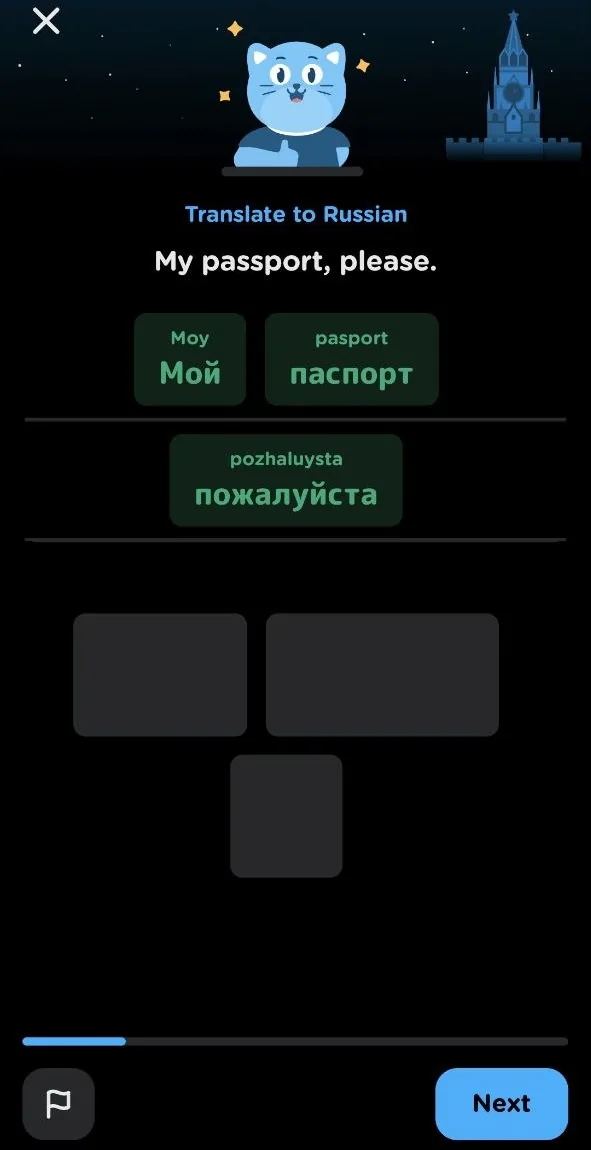
It looks a lot like Duolingo, with streaks, XP, weekly leagues and a blue cat as its mascot. The difference is the lesson design. Each lesson opens with a few short slides that explain a rule or a group of words, often with a note about culture, and only then do the exercises start. The slogan is "learn first, practise next" [1].
What is new in 2026
The app has grown fast. In mid-2026 the founder said it had about 2 million downloads a month without paid marketing, 25 million lessons completed a month and about 110,000 paying subscribers [3]. AI plans made up around a tenth of its bookings.
The course list has grown too. The App Store now says 40+ languages and mentions a new chess course [1]. Independent reviewers count fewer full language courses, between 18 and 24, so check that yours is on the list and how deep it goes [4][5]. Spanish, French, German, Italian, Portuguese, Japanese, Korean and Chinese are the main ones, plus Hindi and several other Indian languages, which few big apps offer.
Is Airlearn free
Partly. You can start with no payment and do about five lessons a day [4]. Because each lesson adds only a few words, five lessons is a small amount of progress, but it is enough to see whether you like the style. Pro removes the daily cap.
Airlearn also sells an AI tutor you can talk to. Reviewers say it sits behind a higher paid plan than plain Pro, and the price is shown in the app, so we do not quote one here. The company says AI subscriptions are about 10 percent of its bookings, so it is still a smaller part of the product [3].
How much Airlearn costs
| Plan | US App Store price |
|---|---|
| Free | 0 dollars, about 5 lessons a day |
| Monthly | 4.99 dollars |
| 6 months | 24.99 dollars, with a 14-day free trial |
| Yearly | 39.99 to 79.99 dollars, with free trials |
| Family | 49.99 dollars |
Prices are from the US App Store in September 2026 [1]. They change by country and offer. Annual plans start with a free trial that turns into a paid plan on its own, so set a reminder before it ends. Duolingo's Super is about 10 to 13 dollars a month for comparison [6], which is why people call Airlearn "half the price".
Our 7-day test
We set one goal: after a week, understand the rule behind a few everyday Spanish sentences and say them without looking. We started on the free plan and added Pro during the week.
- Days 1 to 3. Spanish from zero. Each lesson opened with a slide, then a short quiz. Each one added only one or two new words, which felt slow, and the free lessons for the day ended quickly.
- Day 4. On a lunch break a slide explained ser and estar in three lines, before the quiz asked us to choose between Soy cansada and Estoy cansada. We got it right because we knew why. This was the best moment of the week.
- Day 5 and 6. Pro on. Review sessions brought back the earlier words at the right moment. The AI voice was clear enough in Spanish.
- Day 7. Said the practice sentences out loud. Good enough to be understood, but the app was not the one telling us how it sounded.
- Later, on Japanese. We said Sumimasen, eki wa doko desu ka? to the app twice at home in the evening and it marked us wrong both times, so we turned speaking off and tapped the answer. Store reviewers describe the same thing.
Our honest takeaway: after a week we understood more of the why than after a week on Duolingo. We did not learn many more words, and we did not speak much more.
Is Airlearn legit
Yes, in the plain sense: a real company, real courses, 4.8 on the App Store from about 47,000 ratings and 4.6 on Google Play [1][2]. The word "legit" sometimes means something else, which is whether the app teaches enough for the price, and here the answers are more mixed.
The strongest negative write-up we found, from August 2026, says lessons are very shallow, with one or two words each, the exercises are easy, the AI voiceovers are robotic and Chinese tones sound unnatural [4]. A second review calls the app good for daily habit and clear grammar, but light on speaking and limited for advanced learners [5]. One App Store reviewer asked for professional fact-checking of the AI-written translations [1].
That fits what we saw. It is a real, useful app for a clear start. It is not a full course.
What users say
Store reviewers say the same few things:
- Praise: the grammar slides, the short lessons, the low price and the feeling of actually learning, not memorising. Many say they switched from Duolingo for this reason.
- Complaints: thin lessons, AI images and voices that feel synthetic, speech checking that marks correct answers wrong, and limits on the free plan.
- Mixed: the AI tutor. People like the idea, but some say it costs extra and does not always work well.
Is Airlearn better than Duolingo
For explanations and price, yes. For everything else, it depends. Answer three questions and the tool below tells you which one to try.
| Category | Airlearn | Duolingo |
|---|---|---|
| Grammar explained first | Yes, slides before the quiz | Short tips |
| Languages | 18 to 24 full courses, up to 40+ listed | 40+ courses |
| Free plan | About 5 lessons a day | Every course, with energy and ads |
| Monthly price | 4.99 dollars | About 10 to 13 dollars (Super) |
| Habit design | Good | The best around |
| Speaking practice | Higher AI plan | Video Call moving into Super |
Duolingo has around 58.7 million daily learners as of Q2 2026 and a course that goes further [7]. Our full Airlearn vs Duolingo comparison scores the two side by side, and our page on whether Duolingo is free explains its energy limits.
Who Airlearn is for
Airlearn suits you if you are a beginner who wants to understand the rule first, you learn one of its main languages, or you want the lowest price. It also suits you if you liked Duolingo's streaks but wanted more why.
It does not suit you if you want to reach an advanced level in one app, if you need a rare language, or if your goal is to talk. In that case a Duolingo alternative built for speaking is a better second app.
Where Slova fits
If Airlearn's slides made the rules clear but you still cannot use them in conversation, Slova is worth a look. It builds lessons around why you are learning, whether that is a job, a move or a hobby you love, and every lesson can be done out loud with our AI tutors. All the new words land in one list and come back for review.
Conclusion
Airlearn is good, free to try and legit. It is the clearest cheap way to start a language if you like to understand the rule first, and it is a better first month than many big apps. It is also thin, and its speaking and AI audio have a way to go. Pair it with a real speaking habit, and if you are still choosing, see the best language apps for beginners.
Frequently asked questions
Is Airlearn good?
Yes for beginners who want grammar explained before each quiz, at a low price. It is less good for depth, natural audio and speaking practice.
Is Airlearn legit?
Yes. It is made by Unacademy, an established Indian education company. The App Store rating is 4.8 from about 47,000 ratings. The main criticism is thin lessons, not scams.
Is Airlearn free, and how much does Pro cost?
You can do about five lessons a day for free. Pro is 4.99 dollars a month in the US App Store, with yearly plans from about 40 to 80 dollars. The AI tutor needs a higher plan.
Is Airlearn better than Duolingo?
For explanations and price, yes. For language choice, course depth and a strong free plan, Duolingo is ahead. Many learners use Airlearn for the rules and Duolingo for practice.
Sources
- Airlearn on the App Store rating, plans, prices, languages
- Airlearn on Google Play rating and downloads
- Startuppedia (2026). Airlearn reaches 2 million monthly downloads history, downloads, subscribers
- The Language Closet (2026). Is Airlearn worth the hype? free limit, lesson depth, AI audio
- Think in Italian. Airlearn review strengths and limits
- Duolingo on the App Store Super price
- Duolingo (2026). Q2 2026 shareholder letter daily learners