

Airlearn is better than Duolingo at teaching you the rule before it tests you, and it costs about half as much. Duolingo is better at everything that takes time: 40+ languages, a longer course, a daily habit that sticks and a free plan in every language. Neither app gives you much real speaking.
We tested both side by side from September to October 2026 and checked every price, plan and limit again on 8 October 2026. This page shows our method, a scored rubric, a side-by-side of each part of learning, what store reviewers say, what changed in 2025 and 2026, and who should pick which.
Airlearn
- App Store
- 4.8 46.8K ratings
- Google Play
- 4.6 98.9K ratings
- Google Play installs
- 5M+
- Languages
- 18+ independent count, listing says 40+
- Free plan
- About 5 lessons a day
- Paid plan
- 4.99 dollars a month
Duolingo
- App Store
- 4.7 5.5M ratings
- Google Play
- 4.7 49.8M ratings
- Google Play installs
- 500M+
- Languages
- 40+ courses
- Free plan
- Every course, with ads and energy
- Paid plan
- 9.99 to 12.99 dollars a month
Ratings (number of ratings), installs and US prices from the App Store and Google Play, checked on 8 October 2026 [1][2][3][4]. Airlearn's independent language count comes from an August 2026 review [5].
Airlearn is the newer name. It comes from Unacademy, a large Indian education company [2]. It looks a lot like Duolingo, with streaks, XP and weekly leagues [1]. The difference is in the lesson: Airlearn explains first and quizzes second.
So is Airlearn a better Duolingo, or a cheaper copy? The answer depends on what you want from an app, and we break it down below.
The short answer
You want to understand the rule first, at a low price
A slide explains each rule before the quiz, and Pro costs 4.99 dollars a month. Lessons are thin and the AI audio sounds synthetic.
You want the longest course, the most languages and a free plan
40+ languages, a web version and the strongest habit design. It explains less up front, and energy and ads limit the free plan.
Quick verdict
Here is Duolingo vs Airlearn in one table, with the better pick marked in each row.
| Question | Airlearn | Duolingo |
|---|---|---|
| Best for grammar | Slides before each quiz | Explain My Answer after a mistake |
| Best for beginners | Gentle, rule first | Gentle, practice first |
| Best for speaking | Weak, AI calls cost extra | Weak, Video Call in a few courses |
| Best value | 4.99 dollars a month | 9.99 to 12.99 dollars a month |
| Best free plan | About 5 short lessons a day | Every course, with ads and energy |
| Best for habit | Good | The strongest around |
| Most languages | 18+ courses, listing says 40+ | 40+ courses |
| Deepest course | Thin after the basics | Goes much further |
How we tested
We ran the same six tasks in both apps in September–October 2026, on iPhone and Android, with Airlearn Pro and Duolingo Super. Spanish was our main course in each app, and we used Japanese for the speaking check.
- Task 1, the first ten minutes. Install, sign up and start Spanish from zero. We noted how each app set our level and what it explained before the first quiz.
- Task 2, the rule test. Finish a lesson on ser and estar, then answer a fresh sentence with no hints. We checked whether the app told us why an answer was right or wrong.
- Task 3, seven days in a row. One or two lessons a day, on the free plan first and then on the paid plan. We watched how fast the free allowance ran out and how streaks, reminders and leagues pulled us back.
- Task 4, the speaking check. Say Sumimasen, eki wa doko desu ka? into each app twice, in a quiet room, and see whether it accepts a correct attempt.
- Task 5, the review check. Come back a day and two days later and see which earlier words each app brought back without us asking.
- Task 6, the money check. Open every paywall in the US App Store, write down each plan, trial and limit, and compare it with the store listing on 8 October 2026.
We also read the newest 50 US App Store reviews for each app, checked the official store listings and help pages, and read independent reviews. If we could not verify a claim, we left it out. A rubric is still our judgement, so here is how each criterion was scored, from 0 to 10.
| Criterion | What a high score needs | Airlearn | Duolingo |
|---|---|---|---|
| Explaining the rule | The rule is taught before it is tested, in plain words, with an example | 8 | 6 |
| Daily habit | Short lessons, reminders and rewards that make tomorrow easy | 8 | 10 |
| Speaking practice | You say full sentences and the app tells you what was wrong | 4 | 5 |
| Beginner friendly | A first lesson that needs no prior knowledge and no guessing | 9 | 9 |
| Depth of the course | How far the course goes before it repeats itself | 5 | 8 |
| Value for money | What the free and paid plans give for the price | 9 | 7 |
| Language choice | How many languages have a real course | 6 | 10 |
| Free plan | How much you can learn without paying | 5 | 6 |
Two limits of our method. We went deep on two courses, Spanish and Japanese, so we cannot speak for every course. And problems we did not hit ourselves come from store reviews, which we mark as reviewers' reports.
How they score
Here are the same scores as bars. Airlearn wins two of the eight criteria, Duolingo wins five, and beginner friendliness is a tie.
Our scores after testing both apps in September–October 2026. Higher is better.
AirlearnDuolingo
Explaining the rule
Daily habit
Speaking practice
Beginner friendly
Depth of the course
Value for money
Language choice
Free plan
Duolingo's higher average comes mostly from language choice, depth and habit, not from better teaching. If you only care about understanding a rule and paying little, Airlearn is the stronger pick. If you want one app for a year or more, Duolingo's depth starts to matter more.
Is Airlearn better than Duolingo?
It depends on what you mean by better. Here is the answer by what you may care about.
- Better at explaining. Yes. Airlearn puts the rule on a slide before the quiz. Duolingo mostly explains after you slip.
- Better value. Yes. Pro is 4.99 dollars a month, and the cheapest yearly plan is 39.99 dollars, about half of Duolingo Super's 83.99.
- Better course. No. Duolingo goes further, in more languages, and Airlearn lessons add only one or two words each [5].
- Better habit. No. Duolingo is still the best at making you come back tomorrow.
- Better for speaking. Neither. Both check short sentences, and both keep real AI conversation on a paid tier.
Many learners use Airlearn for the why and Duolingo for the practice. If you want only one, read on.
What Airlearn is like
Airlearn's idea is to learn first and practise next [1]. You choose a language, and each lesson opens with a few short slides that explain a rule or a small group of words, often with a note about culture. Then the quizzes start. The store listing says you can begin with the basics or jump into more advanced modules [1]. We found no placement test, and a paying reviewer asked for one on 28 September 2026.
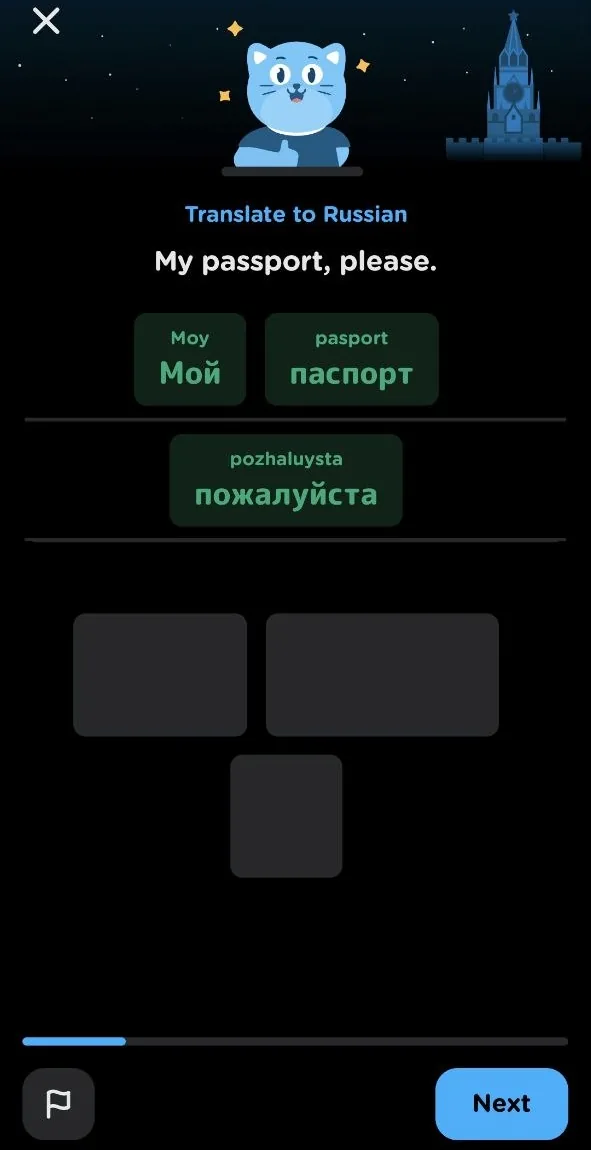
On day four of our Spanish course, in a lunch break, a slide explained ser and estar in three lines before the quiz asked us to pick between Soy cansada and Estoy cansada. We got it right because we knew why, not because we guessed. It also took less than five minutes, and then the free lessons for the day were nearly gone.
The exercises themselves are simple. An independent review that began testing in November 2025 describes mostly matching and fill-the-gap tasks, one or two new words per lesson, and short culture facts between exercises [5]. That is calm and clear, and it is also why progress feels slow.
What Duolingo is like
Duolingo is the app most people start with. You pick a language, then either start from scratch or let the app find your level with a placement test, according to Duolingo's own guide. Each course is a path of units built around goals like ordering food. Lessons are short: you match words, fill gaps, type and repeat sentences. Streaks, leagues and a cheeky owl make it easy to say yes to tomorrow.
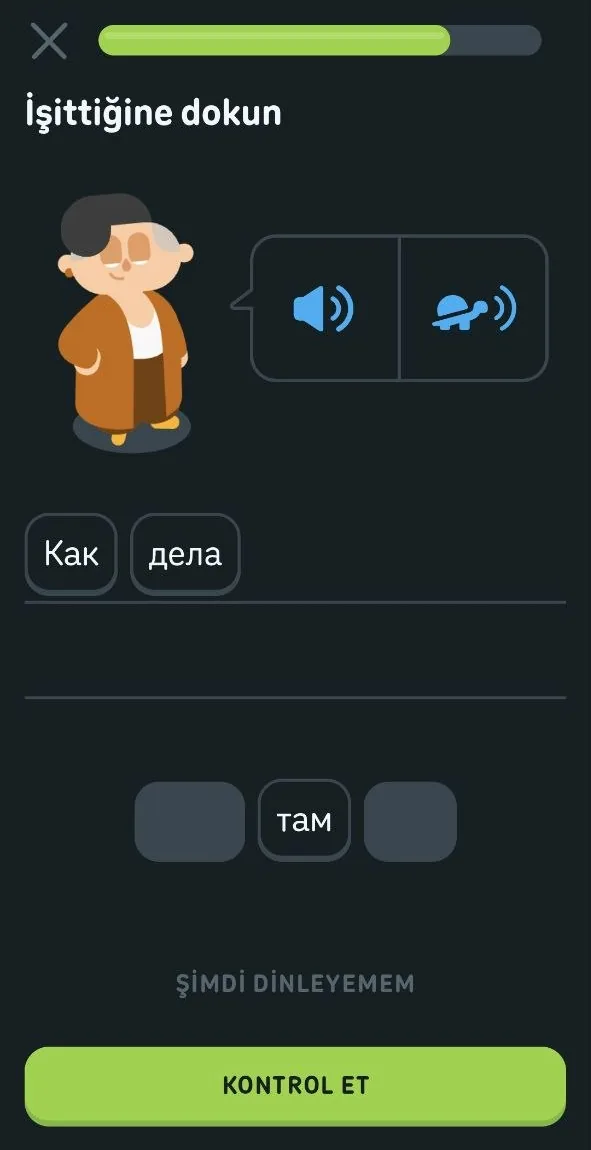
The honest problem is that the lesson rarely stops to explain. On day twelve of our Spanish streak, on the bus, we built Quiero un café, por favor from tiles without a single mistake. Then a new sentence used quisiera, and the lesson gave no note on why. The tip page we opened that evening was short. Our full Duolingo review weighs the whole course.
Duolingo has been fixing this. Since 1 January 2026, Explain My Answer, which tells you why an answer was wrong, is free in most Spanish, French, German, Japanese, Portuguese, Italian and Korean courses [6]. It helps, but it waits for you to ask. We scored Duolingo 6 out of 10 for explaining the rule, against Airlearn's 8.
Lessons and grammar
This is where Airlearn earns its good ratings. You see the rule, you see an example, then you practise it. If you want to know why a sentence works, Airlearn feels kinder from day one.
| Part of a lesson | Airlearn | Duolingo |
|---|---|---|
| How a lesson opens | Short slides with the rule, the words and a culture note | An easy exercise, then harder ones |
| How you practise | Matching and fill-the-gap quizzes | Matching, typing, listening and repeating |
| When you get it wrong | The answer is marked wrong and you try again | The answer is marked wrong, with Explain My Answer on request |
| Where the grammar lives | In the slides, before the quiz | In unit tips and in Explain My Answer |
Duolingo gives you more practice for each rule, and more rules overall. Its units are built around real situations, and the path keeps going long after Airlearn's courses start to feel thin. But most of the explaining is left to you, and many learners end up looking up grammar elsewhere.
The catch with Airlearn is how much each lesson holds. Clear slides are nice. If a lesson adds two words, you need many lessons to get anywhere, and the free plan limits how many you get each day [5]. The same review notes that grammar words such as demonstratives are split across lessons, which can make the order feel random [5].
Speaking and listening
Neither app is a speaking app. Both ask you to repeat short sentences into the microphone, and both check mostly whether they heard the right words, not how you said them.
Our day nine test in Japanese showed the gap. At home in the evening, we said Sumimasen, eki wa doko desu ka? to Airlearn twice and it marked us wrong both times, so we switched speaking off and tapped the answer instead. One reviewer on 22 September 2026 says the app does check that you say the word right, so test it with your own voice. Duolingo heard the same sentence fine, but also let a clearly wrong vowel pass.
For real conversation, both apps keep AI calls on a paid tier, and both have limits.
- Duolingo Video Call. You talk with Lily on a video call. Duolingo's help centre still lists it as a Max feature for English, French, Spanish, Italian, German and Portuguese courses. On its Q2 2026 earnings call, in August, executives said most new Super subscribers now get Video Call and existing Super subscribers should follow over the coming months.
- Airlearn AI calls. Store reviewers say the video calls need a paid plan. A reviewer who paid for six months wrote on 28 September 2026 that the calls are robotic and not very good.
Listening felt more natural on Duolingo in our tests, because Airlearn's AI voices do not sound human yet. The independent review makes the same point and says some Chinese tones sound off [5]. If real speaking is the point, Duolingo vs Speak shows what a spoken course does better.
Vocabulary and review
Airlearn's store listing promises spaced repetition, which means words come back just before you would forget them [1]. In our review check, earlier words did return at the right moment once we were on Pro. New-word screens are wordy, though, and the independent review would rather see short flashcards [5].
Duolingo schedules review for you inside each unit, based on what is due and what you got wrong, according to its own guide. You can also replay finished lessons. It is steady and easy to follow.
Placement and levels
Duolingo asks whether to start from scratch or find your level, and you can skip one unit at a time later. A placement result cannot be undone, but you can review what it skipped.
Airlearn has no placement test that we could find; for Spanish, our Spanish level test can tell you where to start. You choose a module and go. That is fine for a true beginner. It is awkward for someone at A2, and the paying reviewer who called the app useful for refreshing A2-level memory asked for a level test. The independent review also found the lessons diluted [5].
Languages offered
Both listings say 40+ languages. The real picture is less even.
| Detail | Airlearn | Duolingo |
|---|---|---|
| Store listing claim | 40+ languages [1] | 40+ languages [3] |
| Size of the course list | 18 courses counted in August 2026, up from 12 at launch [5] | About 30 languages named, from Spanish to Esperanto, Latin and High Valyrian [3] |
| Newer courses | Swedish and Marathi by November 2025, Telugu and Tamil in December 2025, then Thai and Kannada [5] | Chess, math and music courses [3] |
| Indian languages | Hindi, Marathi, Telugu, Tamil and Kannada [1][5] | Check the course list for yours |
| Less common picks | Dutch, Turkish and Swedish are in the listing [1] | Irish, Welsh, Ukrainian and Greek are named [3] |
If your language is common, both work. If it is Irish, Welsh, Esperanto or Ukrainian, Duolingo is the safer bet. If it is Tamil, Telugu or Marathi, look at Airlearn first. Airlearn also teaches English to speakers of Hindi, Spanish, German, French and Portuguese [1]. In every case, open the course list in the app before you pay.
Price and plans
| Plan | Airlearn | Duolingo |
|---|---|---|
| Free plan | About 5 lessons a day [5] | Every course, with ads and an energy limit [3][7] |
| Free trial | 7 or 14 days on some plans [1] | 14 days for Super, in the listing [3] |
| Monthly | 4.99 dollars [1] | 9.99 to 12.99 dollars (Super) [3] |
| Yearly | 39.99 to 79.99 dollars, 14-day trial on some plans [1] | About 84 dollars, with 95.99 and 119.99 also listed [3] |
| Family | 49.99 dollars (Pro Family Plan) [1] | Super Family, shared with up to 5 other people, price shown in the app |
| AI conversation tier | Sold separately, no published price | Max, which executives said may be sunset |
| Platforms | iPhone and Android | iPhone, Android and web |
Prices are US App Store prices checked on 8 October 2026. They vary by country and offer, so check your own store before you pay. Airlearn also sells a 6-month plan at 24.99 dollars [1]. Annual plans start with a free trial that turns into a paid plan on its own, so set a reminder.
Free limits matter as much as prices. Airlearn gives you about five lessons a day [5], and a reviewer on 30 September 2026 says the app keeps nudging free users toward Premium. Duolingo gives you every course, but its Energy system drains as you study and refills over about a day, by waiting, watching an ad, spending gems or getting answers right in a row [7]. A reviewer on 6 October 2026 says energy runs out after about two lessons. Our page on whether Duolingo is free covers the limits in detail.
Duolingo is also testing a cheaper, ad-supported plan called Super Lite at about half the Super price depending on country, according to a transcript of the Q2 2026 call. So the free-versus-paid line is still moving.
Feature by feature
✓Yes◐Partly✕No
| Feature | Airlearn | Duolingo |
|---|---|---|
| Free to start | ◐about 5 lessons a day | ✓ads and energy |
| Rule explained before practice | ✓slides | ◐Explain My Answer on request |
| Placement or level choice | ◐choose a module | ✓Find my level |
| Spaced review of words | ✓in the listing | ✓practice inside units |
| AI conversation | ◐higher paid tier | ◐Video Call, few courses |
| Streaks, XP and leagues | ✓ | ✓ |
| Family plan | ✓ | ✓ |
| Web version | ✕ | ✓ |
Is Airlearn good? Our honest review
Yes, with limits. Airlearn is a real product from an established company, it is rated 4.8 on the App Store from about 47,000 ratings [1], and it does the one thing it promises: it explains before it tests. For a beginner who learns by understanding, that is worth the price. Our Airlearn review goes further on plans and legitimacy.
Here are the weaknesses we think matter most.
- Thin lessons. Each lesson adds one or two new words, so you need many lessons to move [5].
- Synthetic audio and art. The voices are AI-made and miss stress patterns, and most images look AI-generated [5]. Two reviewers in late September and early October 2026 complain about the pictures.
- A small free plan that nudges you. About five lessons a day [5], and a reviewer on 30 September 2026 says the premium prompts never stop.
- Weak speaking. Speech checking is hit and miss, and the AI calls cost extra and sound robotic to a paying reviewer.
- No placement test and no web version. You start where you tap, and you can study only on a phone.
- Unclear language count. The listing says 40+, an independent count says 18 [1][5].
The sharpest independent review we found, from August 2026, does not recommend Airlearn for learners and says it may suit an absolute beginner only briefly [5]. Store reviewers are far warmer. Our view sits between the two: a good first month, a thin second year.
Where Duolingo falls short
- Energy and ads on the free plan. At least six of the 50 newest US App Store reviews, all posted on 6 October 2026, complain about ads, the energy limit or pressure to pay.
- Explaining comes after the slip. Explain My Answer is free, but it covers courses in seven languages and waits for you to tap [6].
- Speaking is a side feature. Short pass or fail checks, and Video Call only in some courses.
- Clutter. Reviewers on 6 October 2026 complain about pop-ups, chests and a forced age prompt.
- Plan churn. Max is in doubt, Video Call is moving to Super, and Super Lite is in testing. What you pay for may change.
What users say
We read the newest 50 US App Store reviews for each app on 8 October 2026. This is a snapshot, not a survey, and stores lean positive because apps ask happy users to rate. We could not read dated Google Play reviews, so we left them out.
Airlearn's 50 reviews were posted between 19 September and 6 October 2026. Thirty-seven are five stars. Twelve compare the app with Duolingo, and all twelve prefer Airlearn: reviewers say it explains things and teaches useful words. The complaints are specific:
- AI art. A two-star review on 23 September 2026 loves the teaching but dislikes the AI pictures.
- Upgrade prompts. A three-star review on 30 September 2026 says Premium and AI calls are pushed constantly, with only five free lessons a day.
- Robotic calls. A four-star review on 28 September 2026 calls the video calls very robotic.
- Top tier terms. A two-star review on 21 September 2026 says the highest plan is yearly only, with no trial.
- Crashes. A four-star review on 28 September 2026 reports the app crashing, with a 250-day streak at risk.
Duolingo's 50 newest reviews were all posted on 6 October 2026, so they show one day. That day was mixed: 27 five stars, 19 one or two stars. Praise is plain. One long-time user, at over 800 days of use, says it is slow but real, with vocabulary and a feel for grammar building up. Complaints centre on ads, the energy system, pop-ups and a forced age prompt.
What changed in 2025 and 2026
| When | App | What changed |
|---|---|---|
| November to December 2025 | Airlearn | Swedish and Marathi are the newest courses, and Telugu and Tamil follow in December [5] |
| 2026 | Airlearn | Thai and Kannada are added, bringing it to 18 courses by August [5] |
| By October 2026 | Airlearn | A chess course is promoted in the update notes from version 3.20.1 to 3.32.1 [1] |
| July 2025 | Duolingo | Energy is announced as a test, to replace hearts [7] |
| 1 January 2026 | Duolingo | Explain My Answer becomes free for most courses in seven languages [6] |
| By October 2026 | Duolingo | Chess, math and music sit beside the language courses [3] |
| 5 August 2026 | Duolingo | Q2 results show daily users up 23 percent. Executives say most new Super subscribers get Video Call, Max may be sunset and Super Lite is in testing |
Airlearn is adding courses and AI features fast. Duolingo is moving its AI features down to cheaper plans and testing a lower price. Both are still changing, so try the free plan before you pay.
Who should pick which
- A true beginner who hates guessing. Airlearn. The slide before the quiz is the whole point.
- A beginner on a tight budget. Airlearn Pro from 39.99 dollars a year, or Duolingo free if you can live with ads.
- Someone with a long Duolingo streak who keeps asking why. Keep Duolingo, turn on Explain My Answer, and read Airlearn's slides for hard rules.
- A learner of Tamil, Telugu, Marathi, Kannada or Hindi. Look at Airlearn first [5].
- A learner of Irish, Esperanto, Ukrainian or Greek. Duolingo [3].
- Someone who wants to study past the beginner stage. Duolingo, because the path is longer. Airlearn is best for the first months.
- A family of learners. Airlearn's family plan is 49.99 dollars [1]. Duolingo's Family plan shares Super with up to five other people.
- Someone who needs a web version. Duolingo.
- Someone who wants to talk, not tap. Neither. See our list of the best language apps for beginners for options that put speaking first.
Where Slova fits
If the rules are clear and you still cannot say the sentence, you need lessons built around what you want to say. Slova builds a path from your goals (a job, a move, family abroad, a trip) and your interests (football, baking, anime), and every lesson can be done out loud with our AI tutors. Every word you meet goes into one list and comes back for review.
If neither fits
Compare more options in our Duolingo alternatives, or browse the best AI language learning apps.
Conclusion
Airlearn is not just a cheap copy. It fixes Duolingo's biggest teaching gap, the missing explanation, and it costs about half as much. But it is young, its lessons are thin and its AI audio still sounds like AI. Duolingo is bigger, deeper and better at keeping you coming back, and it now explains more than it used to. If you are starting from zero and want to know why, try Airlearn. If you want a long course in almost any language, stay with Duolingo.
Frequently asked questions
Is Airlearn better than Duolingo?
For explaining rules and price, yes: Airlearn shows the rule on a slide before the quiz, and Pro costs 4.99 dollars a month. For languages, depth, habit and a free plan in every course, Duolingo is stronger. We scored Duolingo 7.6 and Airlearn 6.8 out of 10.
Is Airlearn good?
Yes, with limits. It is made by Unacademy, has a 4.8 App Store rating and explains rules well. Lessons add only one or two words, the AI voices sound synthetic, and the free plan stops at about five lessons a day. Use it as a clear, cheap start.
How much do Airlearn and Duolingo cost?
In the US App Store on 8 October 2026, Airlearn Pro is 4.99 dollars a month or 39.99 to 79.99 a year. Duolingo Super is 9.99 to 12.99 dollars a month or about 84 a year. Both have free plans. Prices vary by country.
Can I use Airlearn and Duolingo together?
Yes. Read Airlearn's slide for a rule, then practise the same topic in Duolingo. Just avoid paying for two plans you will not use. Try each free first and keep the one you open every day.
Sources
- Airlearn on the App Store (checked October 2026) plans, prices, ratings, languages and update notes
- Airlearn on Google Play (checked October 2026) rating and installs
- Duolingo on the App Store (checked October 2026) plans, prices, ratings and course list
- Duolingo on Google Play (checked October 2026) rating and installs
- The Language Closet (2026). Is Airlearn worth the hype? lesson depth, free limit, AI audio and course count
- Duolingo (2026). Explain My Answer is now free which courses get free explanations
- Duolingo (2025). Why Duolingo switched to Energy how Energy works and how it refills