
TravelSpeaking roleplay
Asking for directions in English
Ask the way, check the bus stop and repeat the directions back, out loud, with a local who reacts to what you say.
Your level
- Chrislocal person on the street
- 3 levels
- Speak, or type
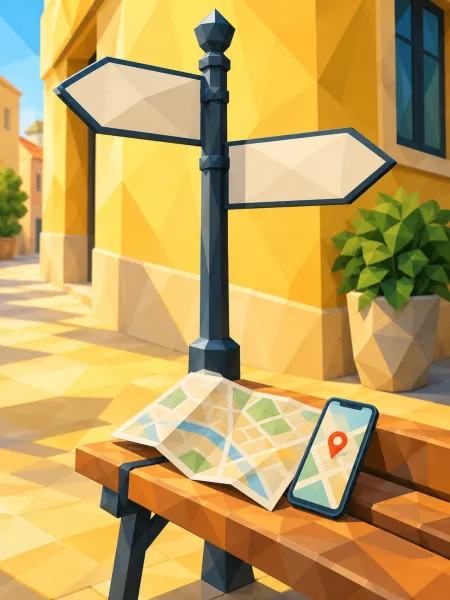
Chris, local person on the street
Are you looking for something? You look a bit lost.
Your goal Get directions, check the details and ask about the bus.
Example conversation: asking for directions
How the roleplay can go at each level, with answers that work. In the roleplay, Chris reacts to your own words, so it can go differently.
BeginnerAsk how to get somewhere and repeat the directions back.
- Chris
Hi, you look a bit lost. Can I help?
- You
Yes, please. How do I get to the station?
- Chris
Oh, I know it. It's not far. Go straight on and turn left at the lights.
- You
Straight on, then left at the lights?
- Chris
Yes, that's it. It's on the right, next to the bank. Okay?
- You
Is it far?
- Chris
No, it's five minutes on foot. Do you want me to show you on the map?
- You
Yes, please. That's very kind.
- Chris
Look, we're here. It's just there. Enjoy your day!
IntermediateGet directions, check the details and ask about the bus.
- Chris
Are you looking for something? You look a bit lost.
- You
Yes. Could you tell me the way to the museum?
- Chris
The museum? You can walk, it's twenty minutes, or take the 14 bus.
- You
I'll take the bus. Which stop do I get off at?
- Chris
Get off at the third stop, Park Gate. When you get there, it's the big building on your left.
- You
So it's on my left, the big building?
- Chris
Right. Anything else you'd like to know?
- You
Can I pay by card on the bus?
- Chris
You can pay on the bus with a card. Enjoy the museum!
Upper intermediateDeal with confusing directions, ask for a better route and chat on the way.
- Chris
You okay there? Is your map sending you in circles?
- You
Yes, it keeps sending me the wrong way. I'm looking for the Old Mill café.
- Chris
It moved to the river. The market's quickest, but packed today.
- You
I don't mind crowds. I'll go through the market.
- Chris
Brave. Keep left, it's quieter. I'm heading that way, actually. I can walk you halfway.
- You
That's really kind of you, thanks.
- Chris
Come on, then. So what brings you here? Just visiting?
- You
Yes, just visiting for the weekend.
- Chris
Oh, nice. From here it's straight down. You can't miss it.
Useful phrases
The phrases the roleplay listens for at each level. Use one and it lights up in the roleplay.
Beginner
- Excuse me, how do I get to…?
- Is it far?
- Left at the lights?
- Can you show me on the map?
- Thanks for your help.
Intermediate
- Could you tell me the way to…?
- I'll take the bus.
- Which stop do I get off at?
- So it's on my left?
- Can I pay by card on the bus?
Upper intermediate
- It keeps sending me the wrong way.
- Is there a quicker way?
- That's really kind of you.
- I think I can take it from here.
- I'm just visiting.
- go straight onkeep walking the same way
- the lightsthe traffic lights
- on footwalking
- get offleave the bus
- a stopa place where the bus stops
- open till sixopen until six o’clock
- in circlesround and round, getting nowhere
- packedvery full of people
- you can't miss itit's very easy to see
Common mistakes
Things people often say here, and a more natural way to say them. If you say one in the roleplay, you see the fix under your answer.
Instead ofWhere is the station is?
SayWhere is the station?
Use “is” only once: where is the station?Instead ofIs far?
SayIs it far?
English needs “it” here: is it far?Instead ofI go to left?
SayI turn left?
We “turn left”, with no “to”.Instead ofHow I can get to the museum?
SayHow can I get to the museum?
In questions, the verb comes first: how can I…?Instead ofWhich stop do I go down?
SayWhich stop do I get off?
You get on and get off a bus.Instead ofWhere do I go down from the bus?
SayWhere do I get off the bus?
You get on and get off a bus.Instead ofThank you for your helping.
SayThank you for your help.
“Help” is the noun here: thanks for your help.Instead ofThe map is showing me crazy.
SayThe map keeps sending me the wrong way.
Use “keeps…” for something that happens again and again.Instead ofWhich is the quickest way?
SayWhat's the quickest way?
Ask “What’s the quickest way?”Instead ofYou don't need to accompany me.
SayYou don't need to walk with me.
“Accompany” sounds formal in a chat.Instead ofI'm here for holiday.
SayI'm here on holiday.
We say “on holiday”.
More roleplays
Eleven more everyday situations, each at three levels. See them all.
 Ordering at a caféOrder a drink and a snack, and pay.
 Checking in at a hotelGet your room and sort out a small problem.
 Checking in at the airportCheck in, sort out your bag and ask about a delay.
 At the doctor'sSay what's wrong and understand what to do.
 Booking by phoneCall a hair salon and book a time.
 Returning somethingExplain what's wrong and ask for your money back.
 Viewing a flatAsk about the rent, the bills and the deposit.
 Small talk with someone newMeet someone at a party and keep the chat going.
 Making plans with a friendSuggest something, agree a time and change the plan.
 Team meetingGive an update, explain a delay and ask for help.
 Ordering at a restaurantGet a table, order a meal and ask for the bill.
 Shopping for clothesAsk for a size, try it on and pay.
 At the pharmacyAsk for something for a cold and how to take it.
 Taking a taxiSay where you are going, check the price and pay.
 Buying a train ticketOne way or return, the platform and a cancelled train.
 Job interviewAnswer real interview questions for your job.